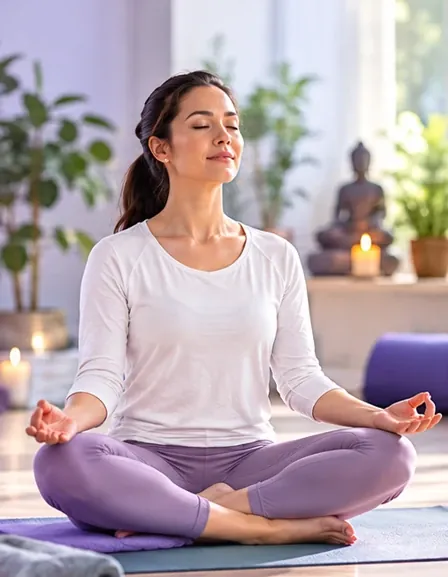
What is meditation?
Meditation is a mental and physical practice that trains attention and awareness to achieve mental clarity, emotional calm and overall wellbeing.
You focus your mind on a particular object, thought or activity to cultivate awareness, concentration and emotional stability. It is not about eliminating thoughts or feelings, but learning to observe them without judgment—helping you gain perspective and reduce reactivity to negative emotions. Meditation can be both a spiritual practice and a secular tool for mental and physical health.
Types and techniques
- Focused attention: concentrating on a single object, such as the breath, a mantra or a visual image.
- Open monitoring: observing thoughts, sensations and emotions without attachment, often associated with mindfulness.
- Movement-based: incorporating gentle movements or walking while maintaining awareness.
- Emotion-centred: cultivating positive emotions like compassion or loving-kindness.
- Body scan: bringing attention to different parts of the body to notice sensations and release tension.
Benefits
Research shows that meditation can reduce stress, anxiety and depression, improve focus and emotional regulation, and enhance overall mental clarity. Physiologically, it can lower blood pressure, heart rate and cortisol levels, supporting cardiovascular and immune health. Regular practice strengthens brain regions associated with attention, memory and emotional control.
How to practise
Meditation can be practised in simple ways, even for a few minutes a day:
- Find a quiet space and sit comfortably.
- Focus on your breath, a mantra or a visual object.
- Notice thoughts and sensations without judgment.
- Gently return your focus whenever your mind wanders.
- Practise consistently, gradually increasing the duration.
Meditation is flexible and can be adapted to individual needs, making it accessible to beginners and experienced practitioners alike. It is a tool for cultivating inner calm, self-awareness and resilience in daily life.
Historical background
The practice of meditation dates back thousands of years, with origins in ancient India around 1500 BCE in the Vedic tradition, known as Dhyana. It has been incorporated into many religious traditions—including Buddhism, Hinduism, Jainism, Christianity, Judaism and Islam—often as a form of prayer, contemplation or mindfulness. Over time, meditation has also been adapted for secular purposes such as stress reduction and cognitive enhancement.